The future has begun
Svetlana Popović Vujotić

Culture

Nova Gorica in Slovenia and Gorizia in Italy, with the arrival of 2026, have completed their one-year mandate as equal holders of the prestigious title of European Capital of Culture.
A unique cultural project, supported by the "Creative Europe" programme, established in 1985 on the initiative of the then Greek Minister of Culture Melina Mercouri, was implemented for the first time as a cross-border project in 2025.
The former line dividing the two countries has become a meeting place and a space for connecting people, culture, art, and historical heritage. This event is a powerful generator of the creative potential of the host cities, as well as a promoter of the unique cultural values and artistic creativity of the Old Continent. The Digital Art Gallery (DAG) in Gorizia is one of the most impressive bridges between the past and the future, created by transforming the “Bombi” Gallery, built during the Habsburg era, which for centuries served as a pedestrian passage through the city, into the largest digital tunnel in Europe.
The impressive imaginary landscape is a testament to the power of culture to make a small community visible on the vast map of European and global contemporary art.
Refik Anadol, the renowned Turkish-American artist, succeeded in integrating digital art and new technologies into it without compromising its historical heritage. The “Data Tunnel,” in the land of Michelangelo and Leonardo da Vinci from the 15th and 16th centuries, in the third millennium confronts us with creativity enhanced by new techniques and artificial intelligence, transforming human imagination and ideas into works of exceptional value.
When we visited Anadol’s “Large AI Nature Model” at the beginning of this year, over 300 meters long—100 of which are fully covered with state-of-the-art LED diodes—within the Digital Art Gallery spanning 1,000 square meters, we were למעשה heading toward a piazza or square, and two European Capitals of Culture.
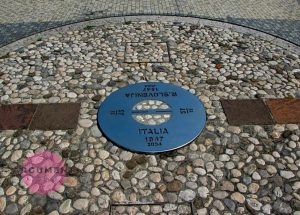
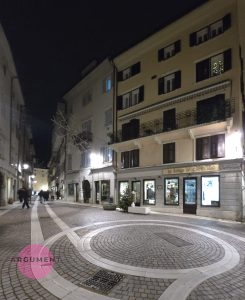
The border is almost invisible and is located in Europe Square.
Charming narrow streets, cultural monuments, impeccably clean pavements, alluring shop windows, heated terraces in elegant outdoor settings, the pleasant interiors of refined cafés and restaurants, affordable prices, welcoming hosts, an ice rink, and original decorations are just part of the atmosphere we encountered.
A long line of patient visitors, noticeable from afar, led us from the main square to the digital tunnel—once a unified space that, after 1945, was divided into two cities: the Slovenian Nova Gorica and the Italian Gorizia—where, besides residents of neighboring countries, there were also many tourists.

Entry to the “tunnel of the future” is free, but reservation is mandatory. The facility can accommodate 490 people at the same time, with a two-way flow. A security barrier opens after ticket verification, and behind it there is staff who monitor and secure the space, which is fully covered by video surveillance. Clear notices indicate who is not recommended to enter the digital interior and for what reasons, and also state that, among other things, touching the sensitive LED wall structure is prohibited.
The atmosphere is unique, like a meditative experience that evokes the deep time of nature. Observing the movement of botanical elements, the sea, atmospheric rhythms, and their transformation into a digitally generated flow is, as the hosts themselves say, as if we have immersed ourselves in a kind of natural dream.
Behind the LED screens displaying a continuous video stream created by an AI model trained on images of nature and data from international museums and scientific archives lies a vast amount of self-supporting structure, bolts, LED cabinets, panels, optical converters and fibers, signal and power cables, electrical conduits, ventilation ducts…
The DAG is operated by five professional workstations and 20 4K video playback signals.
The transformation of the “Bombi” Gallery into a digital art tunnel cost several million euros, but expectations for its valorization are high.
The title of European Capital of Culture 2025 brought the future to the Italian Gorizia and the Slovenian Nova Gorica, leaving behind the lights of culture that will never fade in that cross-border area!
The gallery’s opening hours are available on the website. http://www.go2025.eu
The European Capitals of Culture for 2026 are the cities of Oulu in Finland and Trenčín in Slovakia.
We look forward to our Nikšić and Montenegro joining the selected countries and cities dedicated to culture and European values in 2030.